Chiropractic care, and why it works.
Every adjustment is really about one thing: restoring clear communication between your brain and your body.
What is a subluxation?
A vertebral subluxation is a misalignment in the spine, small, often painless, and easy to miss. But because your spine houses and protects your spinal cord, even a small misalignment can interfere with the signals traveling between your brain and the rest of your body.
This is the core idea behind subluxation-based chiropractic care: find where that communication is interrupted, and correct it. Not just to relieve a symptom, but to restore the connection underneath it.

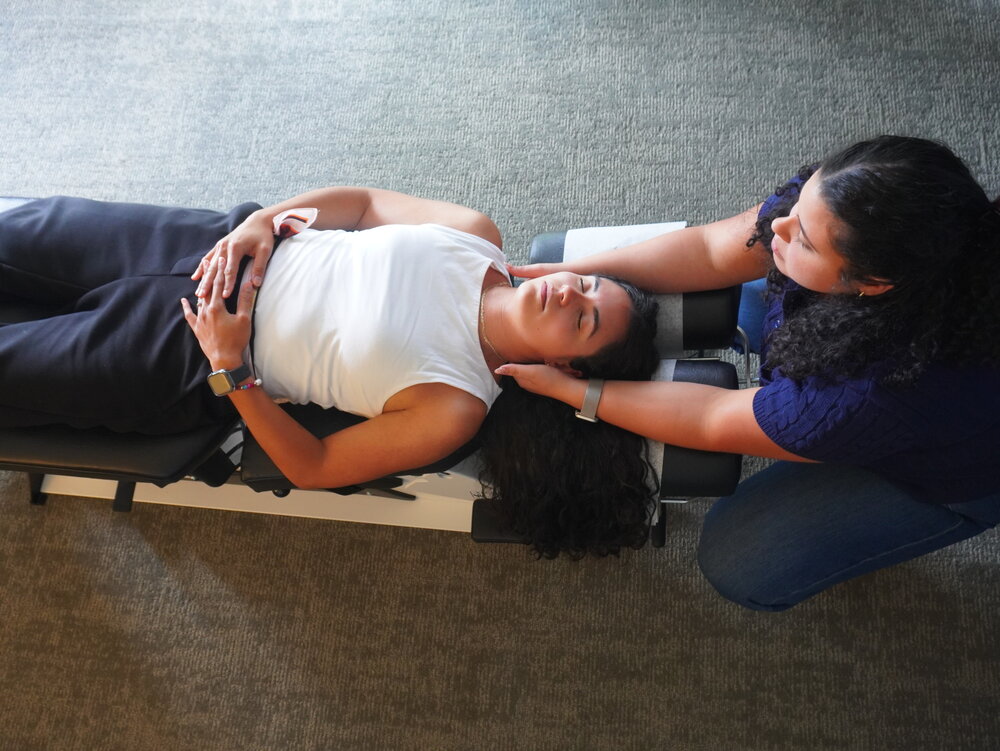
Your spine is more than structure. It's a communication line.
Every organ, muscle, and tissue in your body is wired to your brain through your nervous system, and that entire network runs directly through your spine. When we look at your spine, we're not just looking at posture or alignment. We're looking at how well your brain and body are actually talking to each other.
That's why chiropractic care can support far more than back pain. When communication along that pathway improves, the effects can show up anywhere your nervous system reaches: sleep, digestion, energy, mood, immune function, and how your body handles stress.
Sympathetic vs. Parasympathetic
In plain language.
Your autonomic nervous system runs the functions you don't consciously think about: heart rate, digestion, immune response, healing. It operates through two branches that are always working against each other, like a gas pedal and a brake.
Sympathetic: The Gas Pedal
Your body's stress response. Fight, flight, or freeze. Useful in short bursts, but many high-achievers live here almost constantly: tense, alert, and never quite able to power down.
Parasympathetic: The Brake
Your body's rest, digest, and heal state. This is where real recovery happens, physically and emotionally. It's also the state chronic stress makes hardest to reach.
A misaligned spine can keep your nervous system leaning toward sympathetic mode even when there's no real threat in front of you. Chiropractic adjustments, especially paired with Neuro-Emotional Technique, are aimed at helping your body find its way back to parasympathetic balance more often, and stay there longer.
Proactive, not reactive.
Most people only think about their spine when something hurts. Chiropractic care, at its best, is something else entirely.
Preventative, not just corrective
Care that catches small interferences before they become the problem you finally can't ignore.
Building, not just fixing
A nervous system that adapts well to stress instead of one that's just barely getting by.
Exalting, not depleting
Every visit is meant to add to your capacity, not just patch what stress has worn down.
Multiple techniques, matched to you.
Diversified, Thompson, Activator Methods, Sacro-Occipital Technique, and more, chosen based on your body, your condition, and your comfort level.
Ready to find out what's actually going on?
A thorough exam is the fastest way to know what your body needs. No referral required.